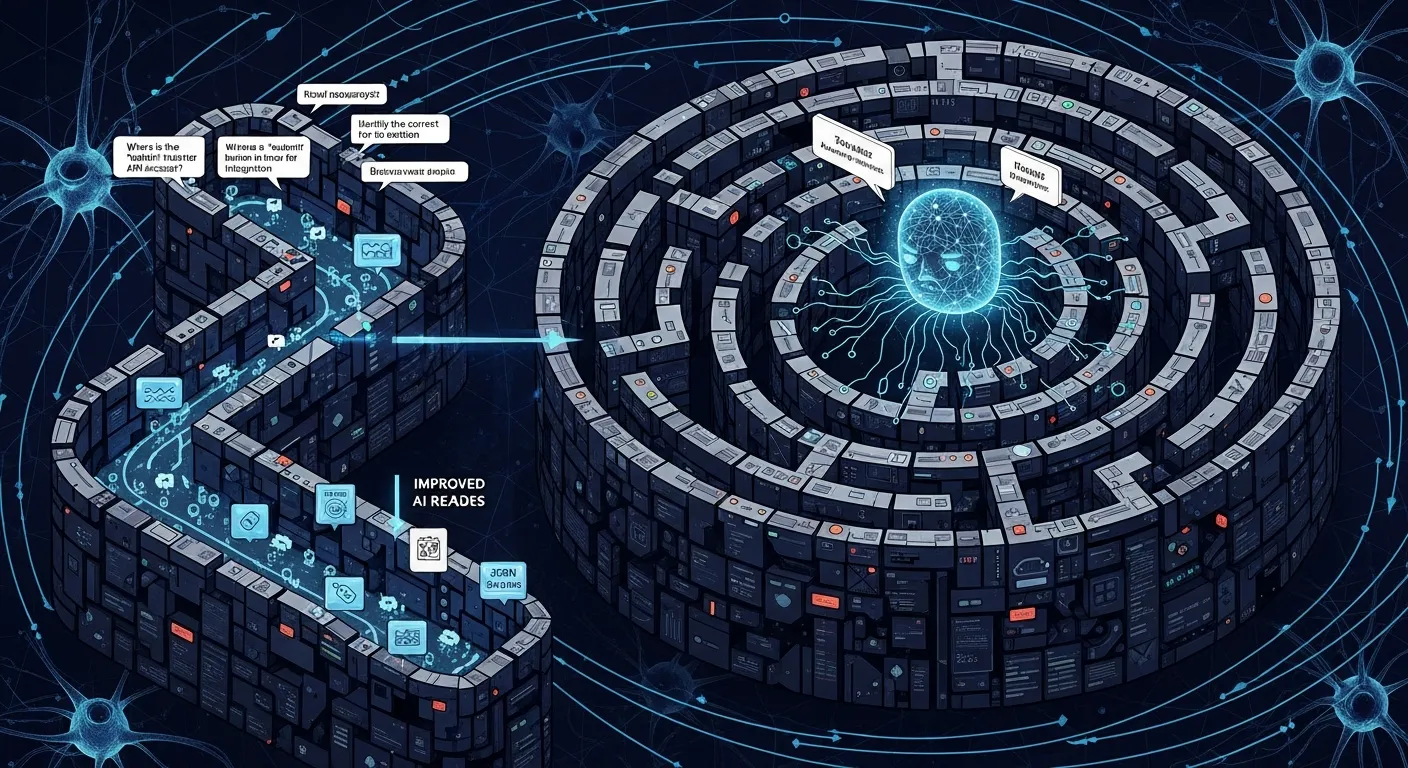
Why AI Agents Fail at Most SaaS Websites
Most SaaS sites score under 40/100 for AI readiness. Here's what that means for the future of agent-driven software and what needs to change.
The Web Was Built for Eyes, Not Algorithms
Think about the last time you visited a SaaS homepage. You scanned it in seconds. You spotted the pricing tab, found the sign-up button, and knew exactly where to click. Your brain filled in a hundred tiny gaps without you noticing.
Now imagine you're an AI agent trying to do the same thing. No eyes. No intuition. Just raw HTML and a task to complete.
That's the problem most SaaS companies haven't faced yet — and a recent audit of 23 well-known SaaS sites shows just how serious it is. The average readiness score for AI interaction across those 23 sites was 35.7 out of 100. Only 4 cleared what most would consider a passing grade.
This isn't a niche developer problem. It's a structural gap in how the web is built — one that's about to matter a lot more.
What "AI Readiness" Actually Means
Before we go further, let's be clear about what we're measuring. AI readiness for a website isn't about chatbots or AI-powered features. It's about something more fundamental.
Can an AI agent land on your homepage and do something useful without a human holding its hand?
Agents are increasingly being used to automate tasks across the web. They browse, click, fill forms, and extract information. They're the backbone of tools that handle scheduling, purchasing, research, and customer service workflows. And they're only getting more capable.
But capability doesn't matter if the website itself isn't readable. An agent reading your page needs labeled form fields, descriptive buttons, and structured data it can map to real actions. Without those, it's essentially working blind.
The audit scoring system reflected this. Points came from things like page coverage, form quality, button clarity, and whether high-intent pages — pricing, checkout, booking — were even accessible in a structured way. Penalties stacked up for poor labeling and missing metadata.
The Numbers Are Worse Than You'd Expect
An average score of 35.7/100 sounds bad. But some of the individual findings make it feel even worse.
Take Stripe. It's one of the most respected developer tools on the internet. Its checkout experience is genuinely excellent. Yet its homepage scored just 4 out of 100 in this audit.
Why? The homepage contains over 2,100 links and more than 200 buttons. There's essentially one form on the entire page — and it's labeled at just 5%. A human visitor glances at a text field and understands what it wants from context, layout, and placeholder text. An agent reading raw HTML sees a blank input with no name attribute and has no idea what to do with it.
This isn't a knock on Stripe's design team. The site is well-designed for humans. The problem is that it was never designed with agents in mind — because until recently, nobody needed to think about that.
Across all 23 sites, button clarity averaged 36.8%. That means most buttons say things like "Learn More" or "Submit" rather than describing the actual action. Humans understand these from context. Agents don't get that context for free.
Only 5 of the 23 sites declared their workflows in any machine-readable format at all. That means on 18 sites, an agent has no structured map of what the site can actually do.
The Gap Between Human-Friendly and Agent-Friendly
Here's the uncomfortable truth: a beautiful, well-designed website can still be completely useless to an AI agent.
Web design has evolved over decades to serve human perception. We respond to visual hierarchy, color contrast, whitespace, and motion. Designers learned to exploit these instincts. They made sites that feel intuitive by working with human psychology.
Agents don't have psychology. They have parsers.
Consider a form with three fields and placeholder text that says "your email," "company name," and "team size." A person fills it out in ten seconds. An agent looking at the raw HTML might see three input elements with no labels, no name attributes, and no aria descriptions. It doesn't know what goes where. It can guess — but guessing creates errors, and errors break workflows.
The sites that scored well in the audit — Beehiiv, Plausible, Raycast, and Lemon Squeezy — share something in common. They tend to be leaner, more developer-focused, and built with cleaner underlying code. That's not a coincidence. Cleaner code is more readable to machines by default.
But most SaaS sites have grown organically over years. Features get added, landing pages get redesigned, marketing teams add new CTAs. Each layer adds complexity. And complexity, without discipline, creates exactly the kind of noise that breaks agent interactions.
Why This Is About to Become a Real Business Problem
You might be wondering why this matters right now. Agents are still relatively new. Most users are still humans clicking through browsers. So why should a SaaS company care about its AI readiness score today?
Because the adoption curve for AI agents is moving fast. Businesses are already deploying agents to handle procurement research, competitor analysis, customer onboarding, and support ticket routing. Many of these agents need to interact with third-party websites as part of their workflows.
When an agent can't complete a task on your site, one of three things happens. The agent fails and a human has to step in, which defeats the purpose. The agent makes a wrong guess and creates bad data. Or the workflow gets redesigned to skip your site entirely and use a competitor's instead.
That last one is the one that should keep product teams up at night.
Consider a company building an AI-powered procurement tool. It needs to check pricing, initiate trials, or request demos across a dozen SaaS vendors. If your site scores 4/100 and a competitor's scores 72/100, the agent will consistently succeed on the competitor's site and fail on yours. Over time, that shapes which tools get recommended, purchased, and renewed.
Agent-friendliness is quietly becoming a competitive advantage — and most companies don't know they're losing ground.
What Actually Needs to Change
The good news is that most of the fixes aren't dramatic. They don't require rebuilding your site or adopting some new framework. They require discipline and awareness.
Start with forms. Every input field should have a proper label element tied to it. Not just placeholder text — an actual HTML label. This is also a basic accessibility requirement, so fixing it helps screen reader users too. It's a two-for-one improvement.
Next, look at your buttons. If a button says "Submit" or "Click Here," ask what it actually does. Name the action. "Start Free Trial" is better than "Submit." "Book a Demo" is better than "Learn More." Descriptive buttons help agents map actions to intent — and they convert better with human users too.
Think about your high-intent pages. Can a machine find your pricing page from your homepage? Is the pricing structured in a way that an agent could read and compare tiers? Is your booking flow labeled clearly enough that an agent could walk through it without guessing?
For teams willing to go further, structured data markup is the next level. Schema.org and similar standards let you declare what your site does in a format machines can reliably parse. This is still rare — only 5 of 23 sites in the audit used it — but it's a meaningful signal of agent-readiness.
None of this is exotic engineering. Most of it is just applying existing web standards more carefully than the average team currently does.
The Broader Shift Happening Right Now
There's a parallel worth drawing here. When mobile browsing took off, companies that had built desktop-only experiences scrambled to adapt. Responsive design went from a nice-to-have to a requirement. Sites that didn't adapt lost traffic, conversions, and eventually customers.
The agent wave feels similar. Right now, most traffic is still human. But the share of automated, agent-driven interactions is growing. And unlike mobile, agents don't have a fallback mode where they squint at a non-optimized page and muddle through. They either succeed or they fail.
The 35.7/100 average across 23 major SaaS sites suggests the industry is early in recognizing this shift. Most teams haven't thought about agent-readiness at all. The ones that start thinking about it now will be in a much better position when agent-driven traffic becomes a meaningful part of the mix.
The web has always evolved to serve whoever's using it. For most of its history, that meant humans. That's no longer the whole story.
If your site can't be used by a machine, you're designing for half your future audience — and you might not even know it yet.
Share this article
Join the newsletter
Get the latest insights delivered to your inbox.